Air Fryer vs Oven: What Each Really Costs to Run
Air fryers get praised for saving money, but is that true for every meal? Here are the watts, the cooking times, and the cost per dish worked out in plain numbers.

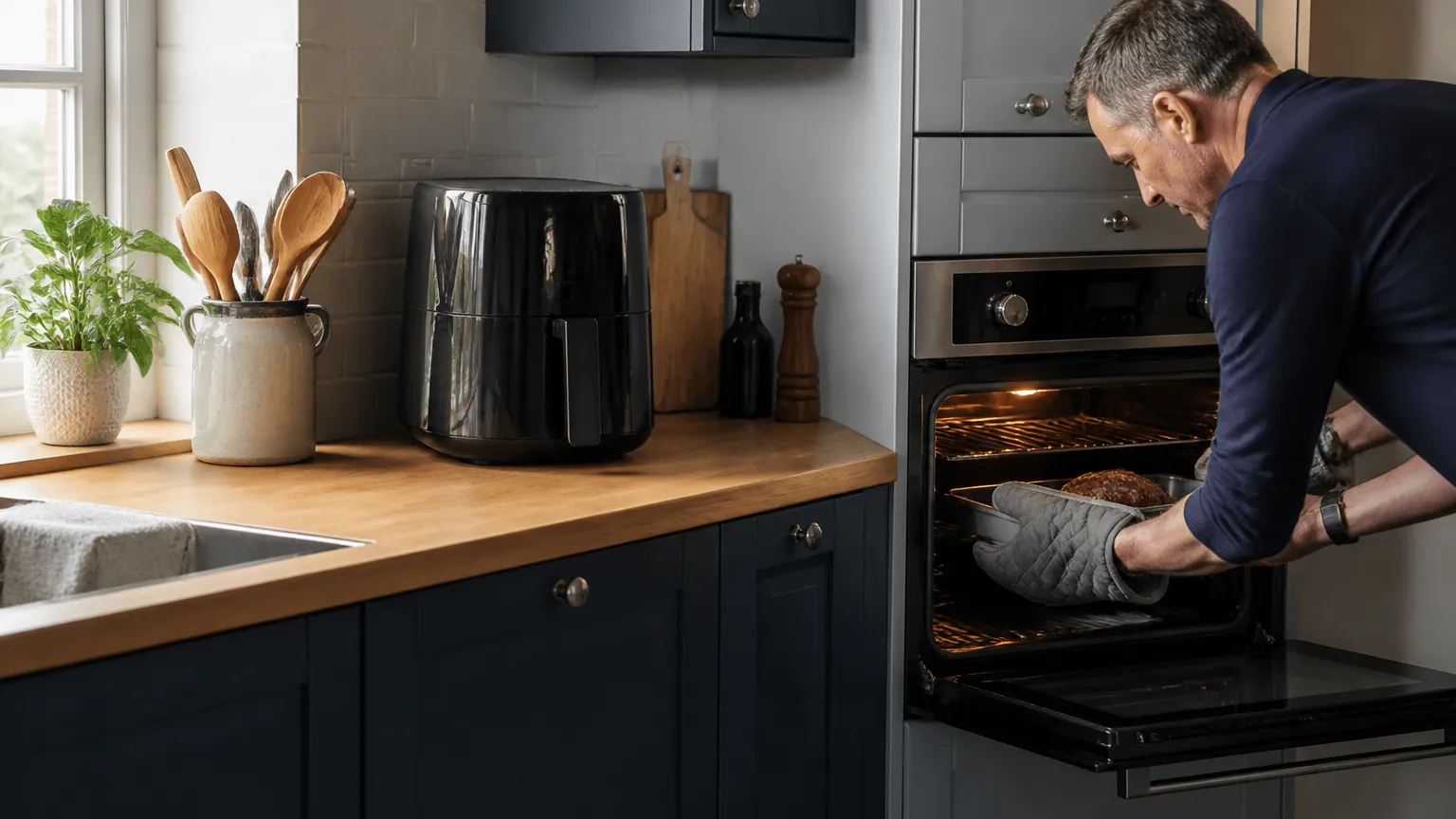
You have probably heard that an air fryer is cheaper to run than your oven. It is often true, but not always, and the gap is smaller than the hype suggests. The real saving comes down to two things: how much power each appliance draws, and how long it runs. A big oven heats a large, well-insulated box, which takes time and energy. A small air fryer heats a cramped space and blows hot air around fast, so it reaches temperature quickly and finishes sooner. Below I have worked through the sums in watts, minutes, and cents, so you can see exactly where the savings land and where they vanish.
How each one uses power
Both appliances work by turning electricity into heat. The difference is scale. A typical full-size electric oven draws somewhere around 2,000 to 2,400 watts (2 to 2.4 kW) when its heating element is on. A countertop air fryer usually draws about 1,400 to 1,800 watts (1.4 to 1.8 kW), with small models closer to 1,000 watts and large dual-basket ones nearer 2,000.
The watts alone do not tell the story, though. An oven keeps cycling its element on and off to hold temperature, so it does not draw full power the whole time. More importantly, it has to heat a large cavity before you even put food in. Preheating a conventional oven to 200°C (390°F) can take 10 to 15 minutes. An air fryer is ready in two or three. That head start, plus shorter cook times for small portions, is where most of the saving comes from.
A quick note on mains voltage, because it affects nothing about the sums but often confuses people. In the UK and Australia, homes run on roughly 230 to 240 volts, so a 2,000-watt appliance draws under 10 amps. In the US and Canada, standard outlets are around 120 volts, so the same 2,000 watts pulls closer to 16 or 17 amps, which is why large US ovens often run on a dedicated 240-volt circuit. The energy used, measured in kilowatt-hours, is the same either way, so the cost comparison below holds up wherever you live.
Working out the cost per meal
Energy is billed in kilowatt-hours (kWh). One kWh is 1,000 watts running for one hour. To get the cost of a cook, multiply the appliance's power in kW by the hours it runs, then multiply by your electricity rate.
Electricity prices vary a lot by country and even by region. For the worked examples I will use 17 US cents per kWh, which is a rough US average. In the UK the figure is closer to 25p per kWh, and in Australia around 30 Australian cents per kWh. Your own bill may be higher or lower, so treat these as illustrations, not promises.
Here is one example in full. Say you reheat a tray of oven fries. In the air fryer that is about 1.5 kW for 15 minutes (0.25 hours):
- 1.5 kW × 0.25 h = 0.375 kWh
- 0.375 kWh × 17 cents = about 6 US cents
- At UK rates: 0.375 × 25p = about 9p
- At Australian rates: 0.375 × 30c = about 11 Australian cents
The same fries in a conventional oven mean preheating for 12 minutes and cooking for 22, so the element is active for roughly 34 minutes. Allowing for the oven cycling on and off, call it an average of 1.6 kW over 0.55 hours:
- 1.6 kW × 0.55 h = 0.88 kWh
- 0.88 kWh × 17 cents = about 15 US cents
So for a single small portion, the air fryer costs roughly a third of the oven. That sounds dramatic, but notice the actual amounts: we are talking about a difference of under 10 cents per cook. You would need to cook a lot of meals before that pays back the price of the appliance.
Cost per dish, side by side
The table below shows approximate costs at the 17-cents-per-kWh US rate. These figures assume an air fryer around 1.5 kW and an oven averaging 1.6 kW including preheat and cycling. Real results depend on your appliance, how full it is, and whether the oven was already hot. To convert, multiply the US cents figure by about 1.5 for UK pence equivalents and about 1.8 for Australian cents.
| Dish | Air fryer time / cost | Oven time / cost |
|---|---|---|
| Frozen fries (one portion) | 15 min / ~6c | 34 min / ~15c |
| Two chicken breasts | 20 min / ~8c | 35 min / ~16c |
| Reheating leftovers | 10 min / ~4c | 25 min / ~11c |
| Roast vegetables (small tray) | 25 min / ~11c | 40 min / ~18c |
| A whole roast chicken | 50 min / ~21c | 80 min / ~34c |
| Batch of cookies (two trays) | Not practical in one go | 15 min / ~7c |
| Family roast dinner (full oven) | Several batches / ~60c+ | 90 min / ~38c |
Two patterns stand out. For small, quick jobs the air fryer wins comfortably. But as soon as you need to cook a lot at once, the oven's larger capacity makes it cheaper, because you heat one big space instead of running several small batches back to back.
When the oven is still the better choice
The air fryer is not a straight replacement. There are jobs where the oven is cheaper, better, or the only sensible option.
- Big batches. Cooking for four or more people usually means several air fryer loads, and each reload starts from a cooler point. One oven run is often cheaper overall.
- Baking. Cakes, bread, large trays of cookies and anything that needs to rise evenly do better in the stable, surrounding heat of an oven. Air fryer fans can dry out or unevenly color delicate bakes.
- Anything with liquid or batter. Casseroles, lasagne and roasts with a lot of liquid suit oven dishes that will not fit most baskets.
- Large or oddly shaped items. A full chicken fits some larger air fryers, but a big joint of meat or several trays at once needs the oven.
In short, the air fryer earns its keep on weeknight portions for one or two people. For a Sunday roast or a baking session, the oven is usually both cheaper and more reliable.
Capacity, basket versus drawer, and what to look for
Air fryers come in two broad styles. Drawer (basket) models pull out like a drawer and are the most common. Oven-style models have a door and shelves, so you can see inside and fit flatter trays, though they take up more counter space. Dual-basket units have two separate drawers, handy for cooking two things at different settings at once.
Capacity is usually quoted in liters (or quarts in the US). A 4-liter model suits one or two people; 6 to 8 liters suits a small family; dual-basket models often total 8 to 10 liters. Bigger is not always better, as a half-empty large air fryer wastes energy heating space you are not using.
Practical points before buying
- Check the wattage on the label, so you can estimate running cost using the sums above.
- Make sure the plug and voltage match your country; appliances bought abroad may not be safe or legal to use on a different mains supply.
- Leave clearance around the vents, as these units blow out hot air and need room to breathe.
- Keep it away from the edge of the counter and out of children's reach, since the outside and the escaping air get genuinely hot.
- Look for a dishwasher-safe basket and a non-stick coating that is easy to clean, as burnt-on residue is the main annoyance over time.
Prices range widely. Basic single-basket models start at around $40 to $70, mid-size units run about $80 to $150, and large dual-basket or oven-style models reach $180 to $300 or more. The cheaper ones cook perfectly well; you are mostly paying for size, extra baskets, and tidier controls.
The short version
- An air fryer draws around 1.4 to 1.8 kW; a full oven draws about 2 to 2.4 kW and takes far longer to preheat.
- For small portions the air fryer typically costs a third to half as much per cook, but the saving is often under 10 cents a meal.
- For big batches, baking, and full roasts, the oven is usually cheaper and gives better results.
- Electricity rates differ: roughly 17 US cents, 25p, or 30 Australian cents per kWh, so adjust the sums to your own bill.
- Buy for the number of people you actually feed, keep it clear of edges and children, and match the plug and voltage to your country.
Emma Clarke
Home & Kitchen writer · Melbourne
Emma covers home and kitchen gadgets, from smart plugs to air fryers. She focuses on what things really cost to buy and run at home, and on the features that matter once the novelty wears off.
Keep reading
Are Electric Kettles With Temperature Control Worth It?
Variable-temperature kettles promise better tea and coffee, but do they earn their keep? Here's what the extra money buys, and when a plain kettle is fine.
What Is an OBD2 Scanner, and Do You Actually Need One?
That little socket under your dashboard can tell you why the check engine light is on. Here's what a scanner reads, what it costs, and who really benefits.
Hidden Car Features: What 'Coding' Can Unlock on VW, Audi and BMW
Many German cars ship with features switched off in software. Here is what coding through the OBD port can turn on, and the risks worth knowing first.
Comments
No comments yet. Share your experience or ask a question.